Training routines, progress tips, and workout-tracking guides.
132 articles to read
Showing 132 of 132 posts
What to look for in a cardio tracking app, especially if you want cardio and strength training logged in one combined training log.
What to look for in a calisthenics app — logging reps and holds as progression markers, saved routines for skill progressions, and a rest timer between sets.
A practical power lifting warm up routine — general warm-up, then ramping sets to your working weight for squat, bench, and deadlift, using an RPE-based approach.
A powerlifting meet day guide covering weigh-in, attempt selection, flights, the 3-lift format, and common first-timer mistakes to avoid.
What makes a good resistance training app — routine templates, a rest timer, logging history, and PR tracking for strength training.
What makes a good hypertrophy app — fast set/rep/weight logging, PR tracking to confirm progressive overload, and muscle-group volume tracking for hypertrophy training.
How powerlifting weight classes work — why bodyweight affects strength potential, how lifters make weight, and how federations structure classes.
How to become a powerlifter, step by step — learning the squat, bench, and deadlift, following a structured program, and finding a federation and local meet.
How to structure calisthenics nutrition for muscle gain — protein intake, calorie surplus, and the strength-to-weight tradeoff unique to calisthenics training.
Can calisthenics training work for weight loss? How bodyweight circuits support conditioning and muscle retention, and why a calorie deficit is still the real driver of fat loss.
A guide to calisthenics skill progressions, with safe step-by-step paths toward advanced skills like the muscle-up, planche, and handstand.
How to structure a calisthenics park workout using pull-up bars, dip bars, and parallel bars, with a sample routine for training outdoors.
The essential equipment for calisthenics training — pull-up bar, gymnastic rings, parallettes, and resistance bands — and what's genuinely needed versus optional.
A guide to meal timing for bodybuilders — how protein distribution across the day matters more than a precise pre- or post-workout window, and why total daily intake still comes first.
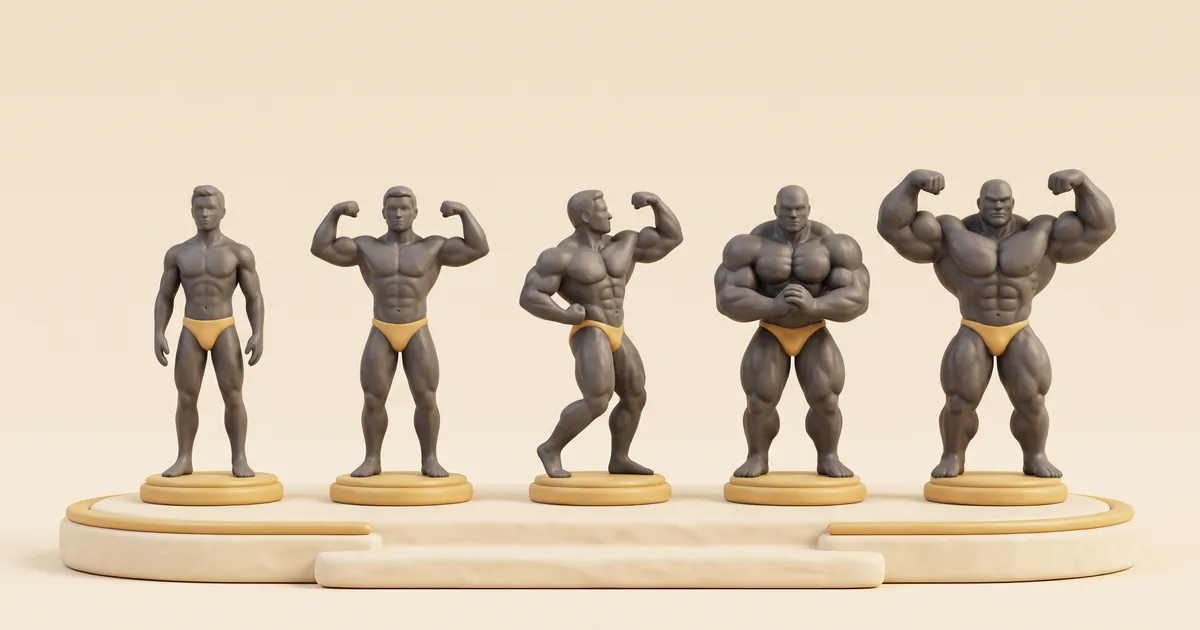
What "open" bodybuilding means, how it differs from classic physique, men's physique, and bikini divisions, and what to expect if you're considering competing in it.
A general explainer of how bodybuilding competitions are judged, covering prejudging rounds, mandatory poses, comparisons, and the criteria judges use like symmetry and conditioning.
A general overview of the history of bodybuilding, from early strongman and physique culture through to how modern competitive bodybuilding developed.
A comparison of classic bodybuilding training splits — bro split, push/pull/legs, and upper/lower — with the pros and cons of each for hypertrophy-focused gym training.
The most common gym routine mistakes — program hopping, no progressive overload, skipping warm-ups, poor recovery, and ego lifting — with simple fixes for each.
The best gym routine for fat loss combines resistance training to preserve muscle with a calorie deficit, using cardio as a supplement rather than the main driver.
A guide to bodybuilding forums and online communities like Reddit, where bodybuilders discuss training and nutrition, and how to evaluate whether the advice you find is trustworthy.
How to structure the best gym routine for women — the same core training principles as any lifter, why strength training doesn't cause unwanted bulk, and realistic goal-setting.
Full body vs split routine compared by training frequency, recovery, and time available — and which suits beginners vs advanced lifters.
A concrete beginner gym routine template — a 3-day-per-week full-body plan with exercises, sets, and reps you can start using today.
A 5-day gym workout split (bro split) template with a sample body-part routine, and an honest look at who it suits and who it doesn't.
A 4-day gym workout split using an upper/lower structure, with sample exercises per day — a middle-ground routine between full-body and body-part splits.
Practical resistance training injury prevention — warm-up, form, gradual load increases, recovery, and how to tell joint pain from normal muscle fatigue.
Resistance bands vs dumbbells and barbells compared — resistance curve, portability, cost, and how each handles progressive overload for resistance training.
Bodyweight resistance training uses push-ups, squats, lunges, dips, and rows to build real strength without equipment. Here's how to structure it and keep progressing.
How to choose the best gym workout routine for your goal and schedule — training frequency, split type, and progression, with links to specific routine templates.
What is resistance training? The definition, how it differs from cardio, and the core principle behind free weights, machines, bands, and bodyweight training.
A resistance training program for beginners — how to start safely with light weight, full-body sessions, and a simple first-week routine you can actually stick to.
A categorized list of resistance training exercises organized by movement pattern — squat, hinge, push, pull, and carry — with examples for each.
The well-established benefits of resistance training — muscle and strength, bone density, metabolic health, and functional independence with age.
The real signs of muscle hypertrophy — strength trends, measurements, and how clothes fit — versus misleading signals like the pump, soreness, and daily scale weight.
Hypertrophy training vs strength training compared — rep ranges, rest periods, intensity, and programming differences, plus how much overlap the two actually share.
A hypertrophy training program for beginners — a straightforward full-body template with sets, reps, and exercises to start building muscle safely and effectively.
The best hypertrophy workout split depends on training frequency and recoverable volume — compare full body, upper/lower, push/pull/legs, and bro splits for muscle growth.
What is hypertrophy? The definition of muscle hypertrophy, how it happens (mechanical tension, metabolic stress, muscle damage), and what actually drives it.
Muscle hypertrophy explained at the fiber level — what mechanical tension, muscle damage, and metabolic stress actually do, and how a muscle adapts over weeks and months of training.
A practical hypertrophy training guide covering rep ranges, weekly volume, proximity to failure, progressive overload, and rest periods for building muscle.
The best hypertrophy rep ranges for muscle growth, why proximity to failure matters more than the exact number, and how to combine rep ranges in a real program.
How much cardio per week you actually need, broken down by goal — general health, fat loss, and endurance — with practical weekly targets for cardio fitness.
A complete gym cardio machines guide comparing the treadmill, elliptical, rowing machine, stair climber, and exercise bike, so you can pick the right one for your goal.
How cardio benefits heart health — resting heart rate, blood pressure, and general activity guidelines — explained in plain terms, without invented statistics.
How to combine cardio and strength training in the same day or week — ordering, timing, and managing the interference effect — without hurting your strength gains.
What is cardio, exactly? The physiological definition of cardiovascular exercise, real-world examples, and why it matters for your heart, lungs, and long-term health.
A structured cardio training guide and workout plan that takes you from your first easy sessions to consistent, effective interval and endurance training over several weeks.
Every major type of cardio exercise explained — steady-state, interval, LISS, and sport-based — with a pros-and-cons comparison to help you choose the right kind.
The best cardio workouts compared by calorie burn, joint impact, and accessibility — running, cycling, rowing, swimming, and jump rope — so you can pick the right one for you.
What a metcon (metabolic conditioning) workout is, how metcons are structured, benefits and risks, and 10 metcon workouts from beginner to advanced for the gym or home.
The unwritten rules of the gym — re-racking weights, sharing equipment, phone use, spotting, open gym manners and more, so beginners feel confident and regulars stay friendly.
The best weight bench exercises for chest, back, shoulders, arms, legs and core, plus a full-body dumbbell and bench workout and what to look for in a gym bench.
The Tabata workout explained — the original 20/10 protocol and research, Tabata vs HIIT, how to set a HIIT timer, and five Tabata workouts for bike, bodyweight and kettlebell.
Be your own personal trainer — set goals, choose a program, manage progressive overload, adjust for recovery, track progress and stay accountable, using the same framework coaches use.
The Arnold split explained — Arnold Schwarzenegger's classic 6-day chest/back, shoulders/arms, legs routine, what made it work, and a realistic modern version for natural lifters.
How to prepare for a natural bodybuilding competition — choosing a tested federation, prep length, dieting phases, training during prep, posing, peak week and what to expect on show day.
Lifting straps vs weightlifting gloves vs chalk compared — what each does, when to use straps, whether gloves are worth it, how to use straps correctly, and how to build grip strength.
How powerlifting compares lifters across bodyweights — the DOTS formula with coefficients, IPF GL points, the old Wilks score, worked examples and a DOTS score table.
A complete CrossFit glossary — what WOD, AMRAP, EMOM, metcon, Rx, box, chipper, kipping, T2B, C2B, DU and more mean, with examples so you can read any whiteboard.
A complete gym bag checklist — the essentials, lifting and cardio extras, post-workout shower items, and how to choose a gym bag that keeps sweaty clothes separate.
How to combine HIIT and weight training — the interference effect explained, best scheduling, which order to do them, sample weekly plans, and how much HIIT is too much.
Calisthenics vs weight training compared on muscle growth, strength, leg training, joint health, cost and progression — plus how to combine both for the best results.
Every major bodybuilding division explained — Open, Classic Physique, Men's Physique, Bikini, Wellness, Figure and Women's Physique — what judges look for, posing, and how to choose yours.
Is a personal trainer worth the money? The real benefits of personal training, typical costs, how to choose a good trainer, and when an app or program is enough.
Hyrox vs CrossFit compared — format, movements, skill level, running, competition structure, injury risk and cost — so you can choose the right fitness race or training style.
How to deadlift safely and effectively — step-by-step setup, conventional vs sumo, common mistakes and fixes, how much you should deadlift, and how to progress.
A practical bodybuilding food list — the best protein, carb and fat sources with macros per serving, how much to eat for bulking and cutting, and a sample day of eating.
What to wear to the gym for lifting, cardio, HIIT and classes — fabrics, fit, gym sets, shoes and what to avoid, with a simple checklist for men and women.
What is calisthenics? The meaning of calisthenics, its proven benefits, the core exercises, the skills people train for, and how to get started with no equipment.
A 20-minute no-equipment HIIT workout at home with beginner, intermediate and advanced versions, quiet apartment-friendly options, timing and how to progress week by week.
Does alcohol kill gains? What research shows about alcohol, muscle protein synthesis, testosterone, recovery and fat loss — and practical ways to drink without wrecking your progress.
Weightlifting shoes explained — what the raised heel does, who needs them, heel heights, and how they compare with CrossFit trainers, flat shoes and running shoes for gym training.
The powerlifting equipment actually worth buying — lever vs prong belts, when to start wearing one, knee sleeves vs wraps, wrist wraps, singlets, shoes and chalk, in order of priority.
Is a gym membership worth the money? Calculate your true cost per workout, compare it with alternatives, and learn the habits that make any gym membership pay off.
The CrossFit Open explained — how the annual online competition works, a recap of 2026 Open workouts 26.1, 26.2 and 26.3, scaled vs Rx divisions, and how to train for next year's Open.
Women's bodybuilding explained — how women should train for muscle, a sample 4-day plan, nutrition and the menstrual cycle, and the competition divisions from bikini to bodybuilding.
Powerlifting for women — why it's one of the fastest-growing strength sports, how to start, a sample 3-day plan, typical strength standards, gear, and what to expect at your first meet.
The home gym equipment that's actually worth buying — prioritised lists for $200, $700, $1,500 and $3,000 budgets, space requirements, and what to skip.
HIIT vs steady-state cardio compared on fat loss, calories burned, heart health, recovery and muscle retention — with a simple way to combine both in your week.
Peptides in bodybuilding explained — what BPC-157, growth hormone secretagogues and other peptides are, what the evidence really shows, 2026 FDA and WADA status, and the risks.
A 12-week Hyrox training plan for beginners — the 8 stations and weights, a weekly schedule mixing running, strength and compromised-running sessions, and pacing tips for race day.
How to find the best gym near you — a 15-point checklist covering location, equipment, crowds, contracts, cleanliness and cost, plus the red flags to walk away from.
Calisthenics for women — the benefits, myths, a 4-week beginner bodyweight plan, and step-by-step progressions to your first push-up and pull-up.
A free 12-week powerlifting program for beginners — 3 days a week, built around the squat, bench press and deadlift, with percentages, accessories, and how to peak for a meet or a max test.
A military calisthenics workout plan inspired by army fitness training — push-ups, sit-ups, pull-ups, runs and circuits, with a free 6-week progression for men and women.
Home gym vs gym membership compared — the real costs, a break-even chart, space and equipment needs, motivation, and which option suits your goals and lifestyle.
A complete bodybuilding program for beginners — a 12-week upper/lower plan with exercises, sets, reps and progression rules, plus how to pick the best bodybuilding app to track it.
How to cancel a gym membership without getting stuck paying — check your contract, send cancellation in writing, stop the payments safely, and what to do if the gym won't let you leave.
HIIT for beginners made simple — how hard to push, the best low-impact exercises, a 4-week progressive HIIT plan, and the mistakes that cause burnout and injury.
How to find the best gym membership deals — when gyms discount, how to negotiate, fees to refuse, and a cost-per-visit table to tell whether a deal is actually good.
The best CrossFit workouts for beginners — 10 WODs you can do at a regular gym or at home, with scaled versions, target times, and how to track your progress on benchmark workouts.
What is powerlifting? The three lifts, how meets and scoring work, weight classes, raw vs equipped, federations like the IPF, and how to start powerlifting as a beginner.
Online personal training vs a workout tracking app compared on cost, accountability, results and who each suits — plus how to get most of a coach's benefits for a fraction of the price.
Olympic weightlifting for beginners — how the snatch and clean & jerk work, the step-by-step learning progressions, a 3-day beginner program, equipment, and common mistakes.
A complete 8-week calisthenics workout plan for beginners — the exact weekly schedule, exercise progressions from push-ups to pull-ups, sets and reps, and how to track your progress.
What is HIIT? The meaning of high-intensity interval training, how it works, its proven benefits, sample work-to-rest ratios, and how often to do it without burning out.
What is CrossFit? A clear explanation of how CrossFit workouts (WODs) work, what a typical class looks like, the real benefits and injury risks, costs, and who it suits best.
Powerlifting vs bodybuilding vs weightlifting explained — the lifts, goals, training styles and equipment of each strength sport, compared side by side so you can pick yours.
Natural bodybuilding explained — how much muscle you can realistically build without drugs, how to train and eat for it, and how to track progress that's slower but permanent.
The hardest part of the gym isn't the workout — it's walking in the first time and coming back. Here's a beginner's plan for your first month: what to bring, what to do, gym etiquette, and how to build the habit.
A beginner-proof way to start a workout plan and actually stick to it — how many days, which exercises, how to progress, and the one habit that separates people who keep going from people who quit.
Most supplements are hype. A short list actually earns its place. Here are the ones with real evidence behind them for building muscle — what they do, how to dose them, and what to skip.
Strong is one of the most polished workout trackers around, especially on Apple Watch. Here's an honest look at where it shines, and where GymMonster offers a different fit.
Recovery takes longer, joints get louder, and the internet has opinions. Here's what actually changes about strength training after 40 — and what stays exactly the same as it did at 25.
RepCount does one thing — counting reps — simply and well. If you've outgrown a basic tally and want structure, routines and progress tracking, here's how GymMonster compares.
MyFitnessPal is excellent for counting calories — it just wasn't built to track your lifts. Here's why a dedicated gym tracker is the better MyFitnessPal alternative if strength training is your actual goal.
One kettlebell and a small patch of floor can build real strength and conditioning. Here's how to structure kettlebell workouts for a home gym, with a sample routine to start.
You don't need to risk a dangerous single-rep attempt to know your 1RM. Here's how the standard formulas work, and how to use your 1RM to program smarter training.
The same weight for six weeks straight isn't bad luck — it's a signal. Here's how to diagnose a real training plateau and the specific fixes that actually move the needle.
A missed week at the gym doesn't erase your gains — but how long does the clock actually give you? Here's what the research says about detraining, and how to protect your muscle during a break.
Hevy is one of the most popular gym trackers for good reason. Here's an honest look at where it excels, where GymMonster differs, and how to decide which fits you better.
No time for a full session? \"Exercise snacks\" — a few minutes of movement scattered through the day — are backed by real research. Here's what they can and can't replace.
Feeling beat up, stalled, or just flat? A deload week might be the fix — not a sign of weakness. Here's when to take one, how to structure it, and how to avoid doing it wrong.
Lifting weights burns fewer calories per minute than running — but the full picture is more interesting than that one stat. Here's what strength training actually does to your calorie burn.
Morning cardio zealots and late-night lifters can't both be right — or can they? Here's what the research actually says about the best time to work out, and why consistency beats the "perfect" hour.
iPhone has no shortage of gym apps — here are the ones actually worth the App Store download in 2026, and the one Telegram-based option that needs no download at all.
The best gym and workout tracker apps for Android in 2026 — what to look for, the top native options, and a Telegram-based alternative with nothing to install.
A roundup of the top gym and workout tracker apps in 2026 — what each one does well, where it falls short, and which one actually fits how you train.
You don't need to pay for a good workout tracker. Here are the best free gym apps in 2026 — what's actually included free, and where the paywalls show up.
\"Fitness app\" covers everything from calorie counters to gym trackers to recovery tools. Here's how to pick the right category for your goal, and the best option in each.
Three gym days a week is enough to build real strength and muscle — if the split is structured right. Here's the best 3-day workout split and how to make it stick.
Rest is the most under-tracked variable in the gym. Here's how long to rest between sets for strength, muscle growth, and endurance — what the research actually says, and why resting too little quietly stalls your gains.
MyFitnessPal is built for counting calories. RepCount is built for counting reps. Here's an honest look at why GymMonster is the better all-round choice for actually tracking your training.
The scale lies and mirrors are moody. Learn how to track body measurements properly and use GymMonster's muscle heatmap to catch training imbalances early.
GymMonster now runs as a native iOS/Android app and as a Telegram Mini App. This honest comparison covers features, speed, offline use and pricing so you can pick the right one.
GymMonster, the gym tracker that started as a Telegram Mini App, is now a native mobile app for iOS and Android. Here's what's inside, what's new, and how to pick your platform.
Looking for a free workout tracker you don't have to download? Here's why a Telegram-based gym log beats bloated fitness apps — and how to start logging in under a minute.
A simple, effective push/pull/legs (PPL) routine for beginners — the exact split, exercises, sets and reps, plus how to track progress so you actually get stronger.
Progressive overload is the key to getting stronger — but only if you track it. Here's what it means, the ways to apply it, and how to log it set by set without a spreadsheet.
An honest comparison of the top workout tracker apps in 2026 — Strong, Hevy and GymMonster. Features, pricing, and the one thing that decides which you'll actually keep using.
The science on training volume is clearer than gym bros admit. Here's how many sets per muscle per week actually build muscle — and the simple way to track your weekly volume.