
Calisthenics Equipment Essentials: What You Actually Need to Get Started
2026-10-18 · 4 min read
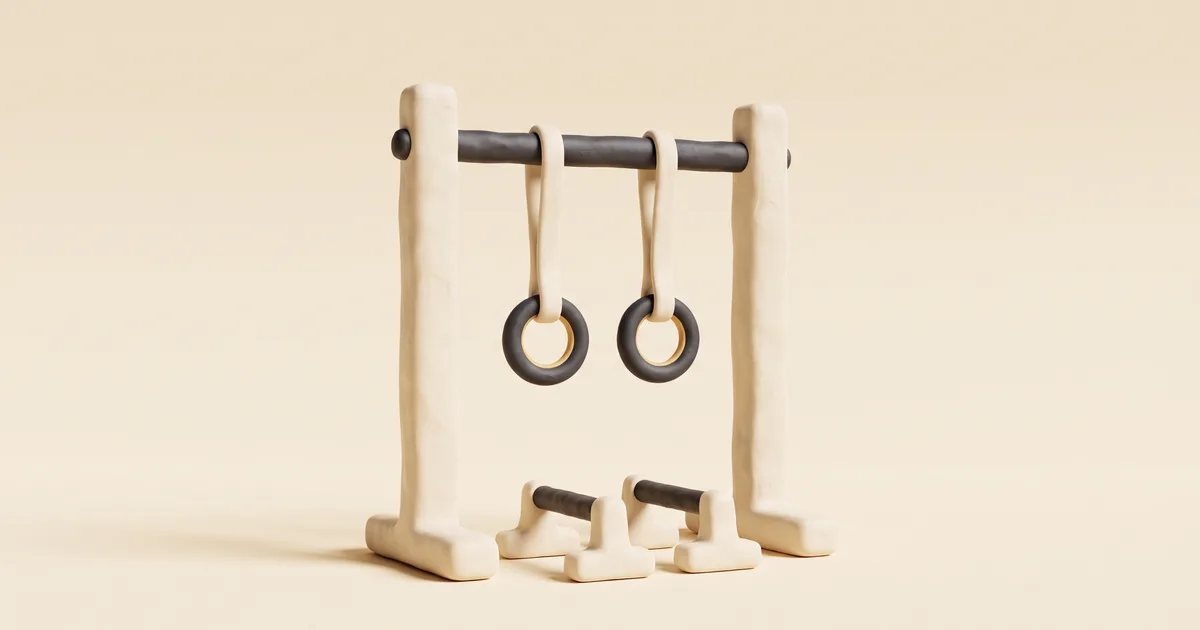
Calisthenics is often pitched as needing zero equipment, and it's true you can get a long way with just your bodyweight and the floor. But a small amount of calisthenics equipment dramatically expands what's trainable — pulling exercises in particular are hard to do at all without something to hang from — so knowing what's actually essential versus optional saves both money and confusion.
The short answer
- A pull-up bar is the single most essential piece of calisthenics equipment — without it, an entire category of pulling exercises is unavailable.
- Gymnastic rings add adjustable difficulty and unlock ring-specific work (rows, dips, more advanced holds) but aren't strictly required to start.
- Parallettes (small parallel bars) make certain push and core exercises easier on the wrists and open up L-sit and handstand training.
- Resistance bands are useful mainly as assistance for exercises you can't yet do at full bodyweight (assisted pull-ups, assisted dips).
- Everything beyond a pull-up bar is an upgrade, not a requirement — you can train seriously for a long time with just a bar and the floor.
The essential: a pull-up bar
Pull-ups, chin-ups, rows, and hanging core work all require something to hang from, and there's no good bodyweight-only substitute for that category of pulling movement. A doorway pull-up bar, a wall or ceiling-mounted bar, or access to an outdoor calisthenics setup all work — what matters is having reliable access to something you can hang and pull from.
If you're only going to buy one piece of equipment for calisthenics, this is it. Push and core exercises have plenty of no-equipment options; pulling exercises largely don't.
Genuinely useful, but optional
| Equipment | What it adds | Needed to start? |
|---|---|---|
| Gymnastic rings | Adjustable difficulty, ring-specific rows/dips, more advanced holds | No, but valuable as you progress |
| Parallettes | Reduced wrist strain, easier L-sit and handstand practice, dip variations | No, optional comfort/versatility upgrade |
| Resistance bands | Assistance for pull-ups/dips you can't yet do unassisted | Helpful for beginners specifically |
| Dip bars / dip station | Dedicated dip training, triceps and chest work | No, push-ups and rings can substitute |
| Weighted vest or belt | Adds resistance once bodyweight reps get easy | No, only relevant once bodyweight exercises are mastered |
Gymnastic rings in particular are popular in calisthenics because they let you adjust difficulty just by changing ring height or body angle, and they add instability that recruits stabilizing muscles more than a fixed bar does. They're a genuine upgrade, but not a starting requirement.
Track this free in GymMonster — on iOS, Android, or right inside Telegram.


What you don't need
- A full home gym setup. Calisthenics is specifically valuable because it doesn't require racks, benches, or heavy plates.
- Specialized shoes or apparel. Comfortable, flexible footwear (or bare feet, depending on the exercise and surface) is all that's needed.
- Every accessory at once. Buying rings, parallettes, bands, and a dip station on day one is unnecessary — add equipment as your training genuinely calls for it, not preemptively.
This is a different equipment philosophy from a traditional home gym setup, which centers on weights and a rack. Calisthenics equipment is smaller, cheaper, and largely optional beyond the pull-up bar.
Building your equipment over time
A reasonable order to add equipment as your training develops:
- Pull-up bar — get this first; it's the one genuine equipment gap in bodyweight training.
- Resistance band — if pull-ups or dips are still out of reach unassisted, a band makes assisted reps possible.
- Parallettes — once you're doing regular push and core work and want easier wrist positioning or L-sit practice.
- Gymnastic rings — once bodyweight basics (pull-ups, dips, push-ups) are solid and you want more variety and instability training.
- Weighted vest — only once bodyweight versions of your key exercises are getting genuinely easy for high reps.
The bottom line
Calisthenics needs far less equipment than a traditional gym, but it's not truly zero-equipment — a pull-up bar is the one piece that opens up an entire category of training, and everything else (rings, parallettes, bands) is a genuine but optional upgrade you can add as your training develops. Whatever equipment you're working with, saving your routine as a program in GymMonster and logging each session's reps keeps your calisthenics progress just as trackable as any weight-room routine.
Frequently asked questions
What is the one essential piece of calisthenics equipment?
A pull-up bar. It's the one piece of equipment that unlocks an entire category of pulling exercises that have no good bodyweight-only substitute.
Do I need gymnastic rings for calisthenics?
No, rings are a valuable upgrade once you've built a base of pull-ups, dips, and push-ups, but they're not required to start training.
What are parallettes used for in calisthenics?
Parallettes are small parallel bars that reduce wrist strain on push exercises and make L-sit and handstand practice easier by raising the hands off the floor.
Can I do calisthenics with no equipment at all?
You can do a lot with bodyweight alone, especially push and core exercises, but without a pull-up bar or similar, you'll be missing an entire category of pulling exercises.
Are resistance bands necessary for calisthenics?
They're not strictly necessary, but they're very useful for beginners who can't yet perform a full pull-up or dip unassisted, since they reduce the effective bodyweight being lifted.
Start tracking your workouts free
GymMonster is free on iOS and Android — or open it right inside Telegram, no download needed. Log your first set in under a minute.