
Home Gym Equipment: What to Buy at Every Budget ($200 to $3,000)
2026-10-01 · 5 min read
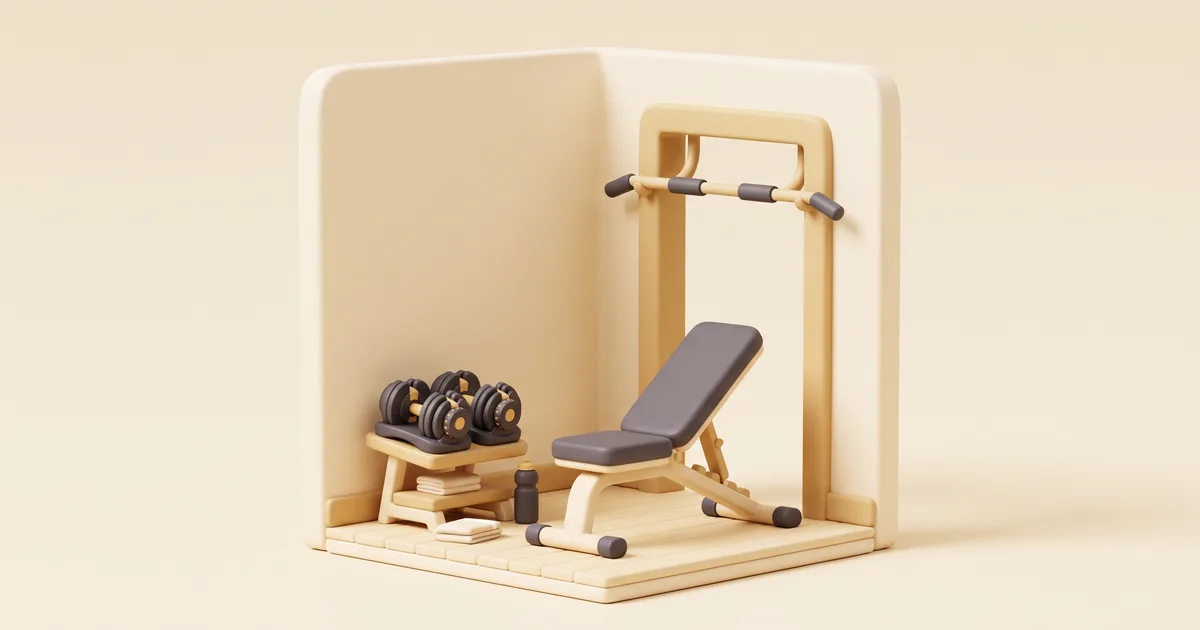
"Home gym equipment" searches rose 70% last year, and "gym bench" and "gym mat" searches rose too. Building a home gym is one of the best fitness investments you can make, but it's easy to waste money on gadgets you'll use twice.
Here's a prioritised buying guide by budget, starting with what gives you the most training per dollar.
Deciding whether to build one at all? Read home gym vs gym membership first.
The short answer
In order of value:
- Adjustable dumbbells: the most versatile single purchase.
- Adjustable bench: doubles your exercise options.
- Pull-up bar (doorframe or wall-mounted): back training for very little money.
- Resistance bands: cheap, portable, great for accessories.
- Power rack + barbell + plates: unlocks heavy squats, bench and deadlifts.
- Flooring: protects the floor, your equipment and your joints.
What each budget gets you
| Budget | Buy | What you can train |
|---|---|---|
| ~$200 | Pull-up bar, resistance bands set, 1 kettlebell (12–24 kg), mat | Full body with calisthenics, kettlebell workouts, bands |
| ~$700 | Adjustable dumbbells + adjustable bench + pull-up bar + bands | Almost any bodybuilding program with dumbbells |
| ~$1,500 | Power rack with safeties + barbell + ~100 kg plates + flat/adjustable bench + flooring | Heavy squat, bench, deadlift, overhead press |
| ~$3,000 | All of the above + adjustable dumbbells + cable attachment / lat-row + rower or bike | A near-complete gym |
Illustrative price levels. New and used prices vary hugely by country. Used equipment often costs 30–60% less.
The essentials, in detail
1. Adjustable dumbbells
One compact pair replaces a whole rack. Look for a range that fits your future strength (up to about 25–40 kg per hand for most lifters), quick weight changes and solid handles. You can press, row, lunge, curl, do Romanian deadlifts and goblet squats.
2. Adjustable bench
Incline, flat and (ideally) decline. Choose one that's stable and has a high weight rating. A wobbly bench is a safety risk. See weight bench exercises for what you can do with one.
3. Pull-up bar
A doorframe bar is the cheapest way to train your back properly. Wall- or rack-mounted bars are sturdier. Combine with bands for assisted pull-ups.
4. Resistance bands
Loop bands and long bands with handles are useful for warm-ups, face pulls, assisted pull-ups, rows and glute work. Inexpensive and they last for years.
Track this free in GymMonster — on iOS, Android, or right inside Telegram.


5. Power rack, barbell and plates
This is where a home gym gets serious. Always get a rack with safety arms or straps. At home you won't have a spotter, so safeties are what let you train heavy alone. A standard 20 kg barbell and about 100–150 kg of plates will last most lifters years.
6. Flooring
Horse-stall mats or rubber gym tiles protect your floor and dampen noise. They're essential if you deadlift.
Space requirements
| Setup | Floor space (approx.) | Ceiling |
|---|---|---|
| Dumbbells + bench | 2 × 2 m | Standard |
| Power rack + barbell | 2.5 × 3 m (bar is 2.2 m wide) | ≥ 2.3 m for pull-ups and overhead press |
| Rower | 2.5 × 0.6 m (many fold upright) | Standard |
Measure twice. Barbell length and ceiling height are the two most common surprises.
What to skip (usually)
- Ab gadgets and "toning" machines. Planks, leg raises and core exercises do the job.
- Cheap all-in-one "home gym" machines. Often limited and wobbly. Free weights are more versatile.
- Very heavy fixed dumbbell sets if space is tight. Adjustables save room.
- Specialty bars before the basics. Nice later, unnecessary at first.
Buying used
Weights barely wear out. Plates, dumbbells, kettlebells and racks are great second-hand buys. Check for cracks in welds, bent bars (roll them on the floor) and rust. Avoid used benches with torn padding or wobbly frames.
Build your routine around your equipment
A home gym works best with a program designed for it. With dumbbells and a bench, an upper/lower or push/pull/legs split is easy to run. With a rack, you can follow a powerlifting program. Browse our home gym exercise library for ideas.
GymMonster lets you build routines for the equipment you actually have, logs every set in seconds and tracks your personal records, so your garage gym gives you a clear record of progress.
The bottom line
Start with adjustable dumbbells, a solid bench and a pull-up bar. That's about $700 and covers most training. Add a rack with safeties, a barbell and plates when you want heavy compound lifts. Skip gadgets, buy used where you can, and measure your space before you order.
Frequently asked questions
What is the most important home gym equipment?
Adjustable dumbbells are the single most versatile purchase, followed by an adjustable bench and a pull-up bar. Together they cover most exercises for a full-body program.
How much does a good home gym cost?
A capable dumbbell-based home gym costs roughly $500–800 new. A full setup with a power rack, barbell, plates and bench typically costs $1,500–3,000, or considerably less if bought used.
Do I need a power rack at home?
Only if you want to train heavy barbell squats and bench presses. If you do, get one with safety arms or straps, since you won't have a spotter at home.
Is it worth buying used gym equipment?
Yes, for plates, dumbbells, kettlebells and racks, which barely wear out. Inspect welds, check barbells for bends and avoid benches with wobbly frames or torn padding.
Start tracking your workouts free
GymMonster is free on iOS and Android — or open it right inside Telegram, no download needed. Log your first set in under a minute.