
Best Gym Workout Routine: How to Pick the Right One for Your Goal
2026-10-14 · 4 min read
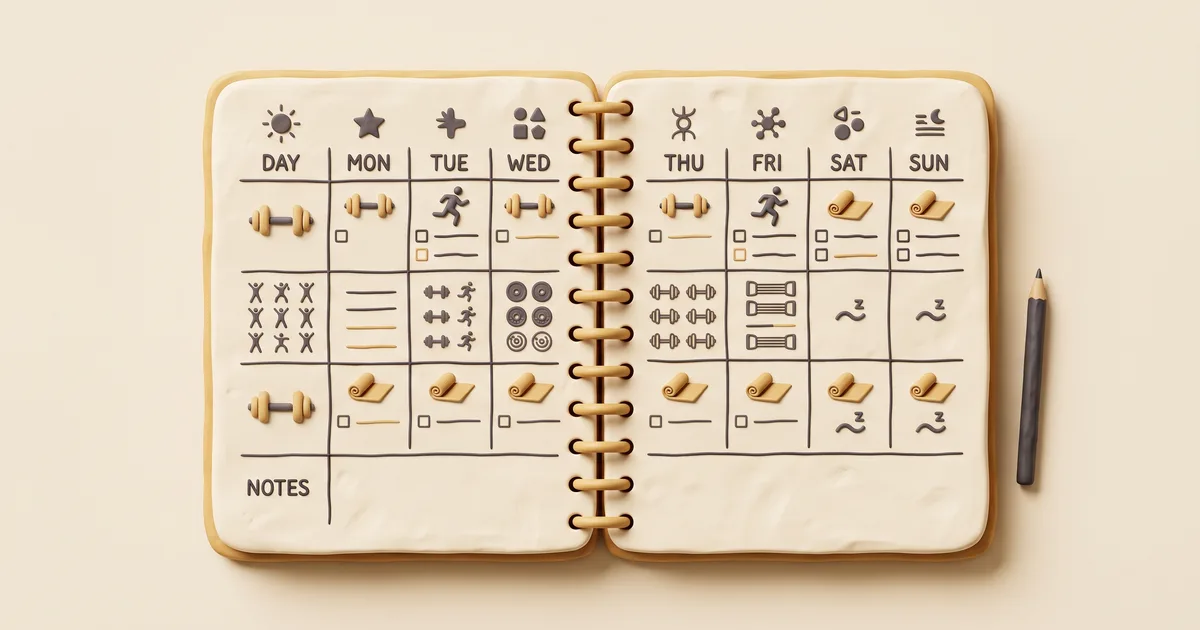
There's no single "best gym workout routine" — the right one depends on how many days a week you can train, your experience level, and whether your goal is strength, muscle, or general fitness. "Best gym routine" is one of the most searched fitness questions precisely because the honest answer is "it depends," and this guide walks through how to actually decide.
Short version: pick your weekly training frequency first, then choose a split structure that fits it, then apply progressive overload consistently. The specific exercises matter far less than getting those three decisions right.
The short answer
- Start with frequency, not exercises — how many days per week can you realistically train, every week, for months?
- 2-3 days: full-body routines. 4 days: upper/lower splits. 5-6 days: body-part splits (bro splits) or push/pull/legs.
- Beginners recover fast and can train each muscle 2-3 times a week; more advanced lifters often need more focused, less frequent-per-muscle splits.
- Progressive overload matters more than split choice — a mediocre split done consistently beats a "perfect" split abandoned after three weeks.
- Consistency beats optimization — the best routine is the one that fits your actual schedule and that you'll still be doing in six months.
Step 1: Decide your weekly frequency honestly
The routine you pick should match the days you can actually, reliably train — not an idealized schedule. Someone training 2-3 days a week and someone training 6 days a week need structurally different routines, because splitting a program into 5-6 muscle-focused days when you only show up 3 times a week means some muscles barely get trained at all.
| Days per week | Best-fit structure | Example article |
|---|---|---|
| 2-3 | Full-body routine | Full body vs split routine |
| 3 (structured) | Push/pull/legs (2x rotation) | Push pull legs routine |
| 4 | Upper/lower split | 4-day gym workout split |
| 5-6 | Body-part (bro) split | 5-day gym workout split |
| Any, new to the gym | Simple full-body template | Beginner gym routine template |
Step 2: Match the split to your experience level
Beginners generally recover fast enough to train each muscle group 2-3 times per week, which makes full-body or upper/lower splits more effective per session than isolating one muscle group per day. More advanced lifters, who need higher total volume per muscle to keep progressing, often benefit from splits that dedicate more focused time to fewer muscle groups per session — which is where a 5-day body-part split becomes more useful than it would be for a beginner.
Track this free in GymMonster — on iOS, Android, or right inside Telegram.


Step 3: Build in progressive overload from day one
Whatever split you choose, the routine only works if you're tracking and gradually increasing weight, reps, or sets over time — this is progressive overload tracking, and it's the actual mechanism behind getting stronger and building muscle, not the specific exercise selection. A basic routine with consistent progressive overload will outperform an elaborate routine where every session looks the same as the last.
Common mistakes when choosing a routine
- Copying a routine built for someone with a different schedule — a 6-day pro bodybuilder split doesn't fit someone with 3 gym days a week.
- Switching routines every few weeks — programs need weeks to months to show results; hopping between them resets progress rather than building on it. See gym routine mistakes to avoid for more on this.
- Ignoring recovery capacity — more days doesn't always mean more progress if you can't recover between them.
- Picking a routine you won't enjoy — the "best" routine on paper is worthless if it's demotivating enough that you stop going.
When to change your routine
A routine doesn't need to change just because a few weeks have passed. Reasonable triggers to reconsider your split are: your available training days changing, your progress stalling for several weeks despite consistent effort (see how to break a training plateau), or your goal shifting from general fitness to a more specific target like strength or a physique goal.
The bottom line
The best gym workout routine is the one structured around your real weekly schedule, matched to your experience level, and applied consistently with progressive overload — not a specific list of exercises copied from someone else's program. Logging every session in GymMonster, including which routine day you did and how the weights felt, makes it obvious whether your current split is actually working or just familiar.
Frequently asked questions
How do I know which gym routine is right for me?
Start with how many days per week you can realistically train — 2-3 days suits full-body routines, 4 days suits upper/lower splits, and 5-6 days suits body-part splits. Match the structure to your actual schedule first, then your experience level.
Is a full-body routine better than a split routine?
Neither is universally better. Full-body routines work well for beginners and people training fewer days per week, while splits let more advanced lifters focus more volume on fewer muscle groups per session.
How often should I change my gym routine?
Only when your schedule changes, progress stalls for several weeks despite consistent effort, or your goals shift. Switching routines every few weeks prevents you from seeing whether a program is actually working.
Do I need a different routine for muscle vs strength goals?
The core structure (frequency, split type) can stay similar, but rep ranges, set volume, and exercise selection typically shift — strength-focused training uses lower reps and heavier loads, while hypertrophy uses moderate reps and more total volume.
Can beginners use the same routines as advanced lifters?
They can follow a similar split structure, but beginners generally need less total volume and can train each muscle more frequently per week than advanced lifters, who need more targeted volume to keep progressing.
Start tracking your workouts free
GymMonster is free on iOS and Android — or open it right inside Telegram, no download needed. Log your first set in under a minute.