
Resistance Bands vs Weights: Which Builds More Strength?
2026-10-14 · 4 min read
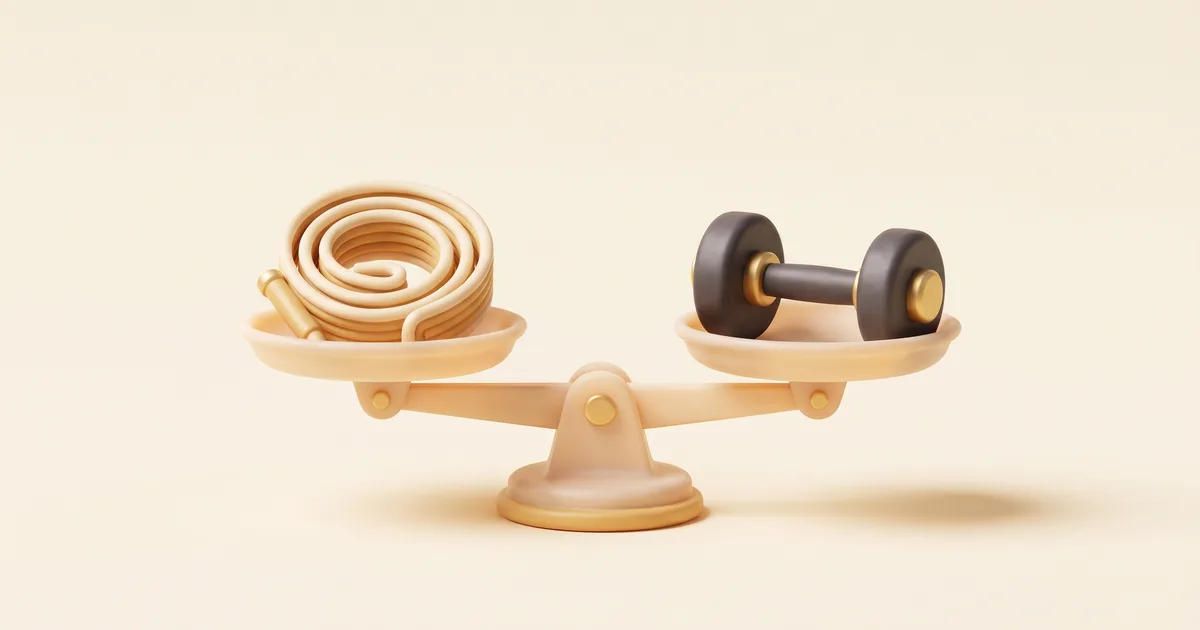
Resistance bands and free weights both provide resistance training, but they load your muscles in fundamentally different ways. "Resistance bands vs dumbbells" is a common question for people building a home gym or deciding what to pack for travel, and the honest answer depends on what you're training for.
Short version: free weights are better for maximal strength and long-term progressive overload; bands are better for portability, joint-friendly accessory work, and adding variable resistance to movements. Most serious lifters end up using both, not choosing one forever.
The short answer
- Bands provide variable resistance — light at the start of the movement, heaviest at full stretch — while free weights provide constant resistance throughout the range of motion.
- Free weights are easier to track and progress because the load is a fixed, known number (a 20kg dumbbell is always 20kg).
- Bands are cheaper and far more portable — a set of bands fits in a bag; a barbell and plates don't.
- Bands are gentler on joints at the start of a rep, which makes them useful for warm-ups, rehab, and accessory work.
- Bands have a rep-range ceiling problem — once you're strong, even the heaviest bands run out of resistance, capping how much stimulus they can add.
How the resistance curve actually differs
A dumbbell curl loads your bicep with the same weight whether your elbow is at 10 degrees or 90 degrees of bend — gravity doesn't change. A band curl, by contrast, is nearly weightless at the bottom of the rep and increasingly resistant as the band stretches toward the top. That's called a variable resistance curve, and it changes which part of the range of motion feels hardest.
For some movements this variable curve actually matches the muscle's natural strength curve well (a squat gets mechanically easier at the top for a barbell, but a band keeps tension high there). For others, it means the hardest part of the band exercise is at the end range rather than where the muscle is usually weakest, which is a different training stimulus than a free weight gives.
Comparison table
| Factor | Resistance bands | Free weights (dumbbells/barbell) |
|---|---|---|
| Resistance type | Variable — increases through the rep | Constant — same load throughout |
| Progressive overload | Harder to measure precisely; bands are graded loosely | Easy to track exactly (add 2.5kg, etc.) |
| Portability | Excellent — fits in a bag | Poor — heavy, needs storage space |
| Cost | Low ($20-60 for a full set) | Higher, especially for a full dumbbell/plate set |
| Joint stress | Lower at the start of the rep | Constant load can be harder on joints in weak positions |
| Ceiling for advanced lifters | Limited — even heavy bands cap out | Effectively unlimited (add more plates) |
| Best use case | Warm-ups, travel, accessory/rehab work | Primary strength and hypertrophy training |
Track this free in GymMonster — on iOS, Android, or right inside Telegram.


Where bands genuinely win
Bands shine for movements where you want tension at a stretched position — like banded lateral raises or pull-aparts for shoulder health — and for warming up a joint before loading it heavily. They're also the practical choice when you're traveling or don't have room for a home gym, since home gym equipment essentials gets a lot lighter and cheaper when bands are part of the plan instead of a full rack.
Where free weights genuinely win
If your main goal is getting stronger on a squat, deadlift, bench press, or row — the core of most resistance training programs — free weights are the more direct tool. The load is precise, you can track progressive overload exactly, and there's no practical ceiling once you get stronger, unlike bands which eventually run out of resistance even at their heaviest rating.
Using both together
Many lifters use free weights as the primary driver of strength and bands as a supplement — for warm-up activation sets, for adding accommodating resistance to a barbell lift (band-resisted squats), or for accessory work on days without full gym access. Neither tool has to be the only one in your program.
The bottom line
Resistance bands and free weights aren't competitors so much as different tools for different jobs — bands for portability, joint-friendly work, and variable tension; free weights for precise, trackable progressive overload. Whichever you use on a given day, logging the exercise, sets, and reps in GymMonster keeps your training consistent even when the equipment itself changes from a home band session to a full gym day.
Frequently asked questions
Can you build muscle with resistance bands alone?
Yes, especially for beginners. Bands can create enough mechanical tension to build strength and muscle, though very advanced lifters will eventually need heavier bands or free weights to keep progressing once even the strongest bands stop feeling challenging.
Are resistance bands as effective as dumbbells?
For many exercises, effectiveness is similar in the early stages of training. The main practical difference is that dumbbells make it easier to precisely track and increase load over time, which matters more as you get stronger.
Do resistance bands lose their resistance over time?
Yes. Bands stretch and degrade with heavy use and sun exposure, gradually providing less resistance than when new. Replacing worn bands periodically keeps your training load consistent.
What's a good starter set of resistance bands?
A set with 3-5 different resistance levels (light to heavy) covers most warm-up, accessory, and portable full-body training needs without overspending.
Should beginners start with bands or weights?
Either works to start. Bands are a lower-cost, lower-intimidation entry point, but transitioning to free weights sooner rather than later makes progressive overload easier to track as you get stronger.
Start tracking your workouts free
GymMonster is free on iOS and Android — or open it right inside Telegram, no download needed. Log your first set in under a minute.