
The Best 3-Day Workout Split (And How to Actually Follow It)
2026-09-13 · 3 min read
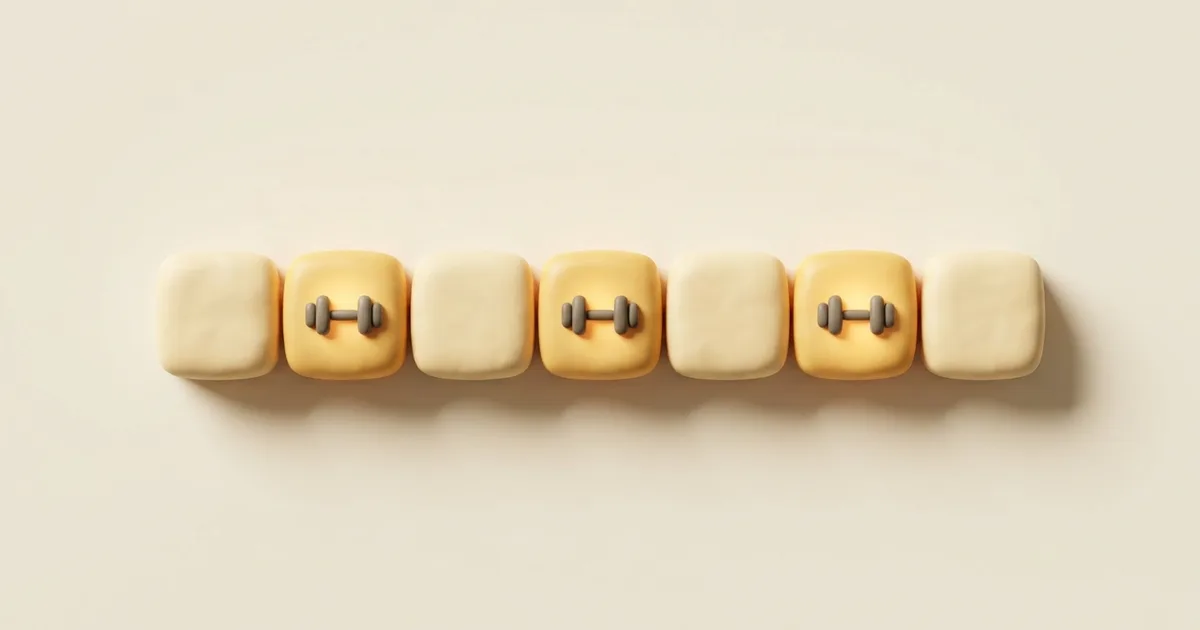
Three days a week doesn't sound like enough to build serious strength — but it's plenty, if the split is structured to hit every muscle group with enough frequency and the right recovery between sessions.
The best structure for 3 days a week: full-body
For most people training only 3 days a week, a full-body split beats a traditional body-part split (chest day, back day, leg day). Hitting each major muscle group roughly twice a week produces better results than hitting it once hard and then not again for 6-7 days — training frequency matters more than most people assume for muscle growth.
A simple, effective 3-day full-body template:
Day A
- Squat or leg press — 3-4 sets
- Bench press or push-up — 3-4 sets
- Row (barbell, dumbbell, or cable) — 3-4 sets
- Overhead press — 2-3 sets
- Plank or core work — 2-3 sets
Day B
- Deadlift or hip hinge variation — 3-4 sets
- Incline press — 3-4 sets
- Pull-up or lat pulldown — 3-4 sets
- Lateral raise — 2-3 sets
- Core work — 2-3 sets
Day C
- Repeat Day A or Day B with different exercise variations (e.g. front squat instead of back squat) to add variety while keeping the same movement patterns.
Train these on non-consecutive days (e.g. Monday, Wednesday, Friday) to give each muscle group roughly 48 hours to recover between sessions.
Why full-body beats a body-part split at low frequency
A body-part split that hits chest once a week works well at 4-6 training days, where each muscle still gets trained often enough. Squeeze the same split into 3 days a week and each muscle only gets trained once every 7 days — well below the frequency most research suggests is optimal for muscle growth. Full-body training spreads the same weekly volume across more sessions per muscle, which tends to produce better results at lower training frequencies.
Making it actually sustainable
The split on paper matters less than whether you actually complete all three sessions, week after week, for months. Two adjustments that help:
- Keep each session under an hour — a 3-day split is meant to be efficient, not a substitute for a 6-day bodybuilding split crammed into fewer visits.
- Rotate exercise variations every few weeks (e.g. different squat or press variations) to keep sessions interesting without abandoning the underlying structure.
Track this free in GymMonster — on iOS, Android, or right inside Telegram.


Following through on the plan
The gap between "a good 3-day split" and "a 3-day split that actually builds strength" is consistency over months, not the exact exercise selection. A routine that's pre-built into your tracker and reminds you which of the three sessions is next removes the daily decision-making that quietly derails a lot of otherwise-solid programs — you show up, open the routine, and the plan tells you exactly what today's session is.
The takeaway
A full-body 3-day split, trained on non-consecutive days with 3-4 sets per major movement, is one of the most efficient ways to build real strength and muscle on limited weekly gym time. The exercises matter less than actually completing all three sessions, week after week — build the split around your real schedule, not an idealized one.
Frequently asked questions
Is a 3-day split enough to build muscle?
Yes — a full-body 3-day split, trained consistently with adequate volume per muscle group, is enough to build real strength and muscle for most people, especially compared to sporadic training on a more ambitious schedule.
Should I do a full-body split or a body-part split with 3 days a week?
Full-body generally works better at 3 days a week, since it trains each muscle group roughly twice weekly instead of once, which better matches the training frequency most research supports for muscle growth.
How long should each session be on a 3-day split?
45-60 minutes is typical for a well-structured full-body session covering 5-6 exercises with appropriate rest between sets.
Can I add a 4th day later?
Yes — many lifters start with 3 days and progress to 4 as schedule and recovery capacity allow, which opens up options like an upper/lower split.
Start tracking your workouts free
GymMonster is free on iOS and Android — or open it right inside Telegram, no download needed. Log your first set in under a minute.