
Powerlifting vs Bodybuilding vs Weightlifting: Which Strength Sport Fits You?
2026-09-26 · 6 min read
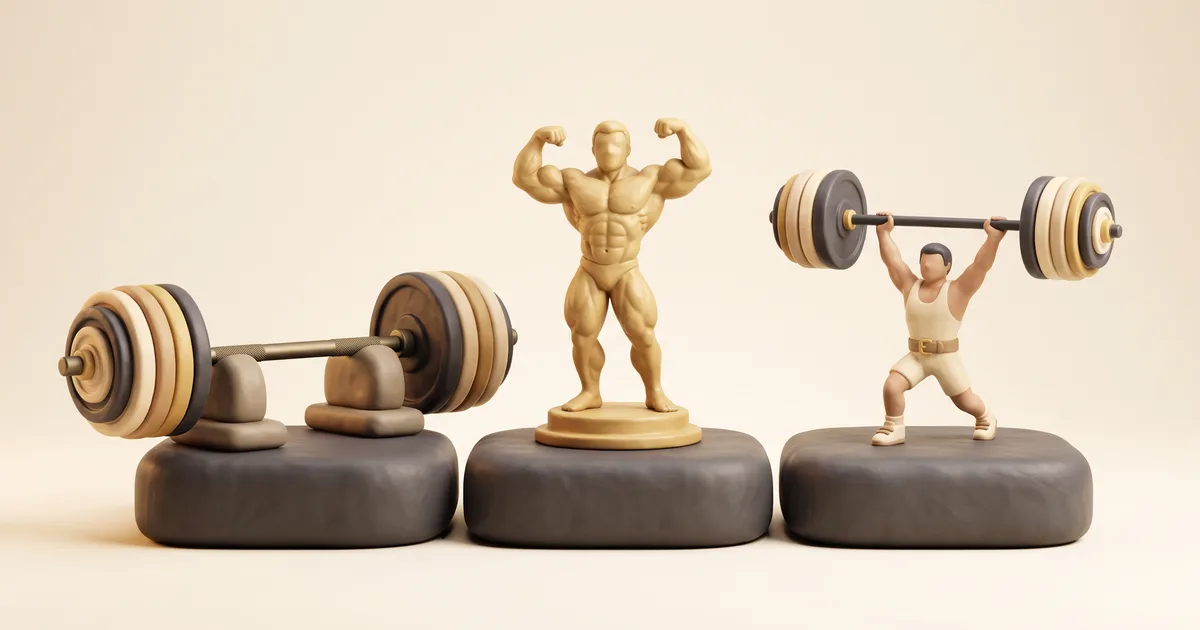
"Lifting weights" covers three very different sports. Powerlifting is about how much you can lift. Bodybuilding is about how you look. Olympic weightlifting is about how fast and explosively you can move a barbell overhead. They share a gym floor and a lot of equipment, but the goals, training and even the shoes are different.
This guide compares all three side by side so you can choose one. If you just want to get stronger and look better, you can also borrow the best parts of each.
The short answer
| Powerlifting | Bodybuilding | Olympic weightlifting | |
|---|---|---|---|
| Goal | Lift the most weight, once | Build a muscular, symmetrical, lean physique | Lift the most weight overhead, explosively |
| Competition lifts | Squat, bench press, deadlift | None — judged on stage | Snatch, clean & jerk |
| Typical reps | 1–6 | 6–15 | 1–3 |
| Key quality | Maximal strength | Muscle size and leanness | Power, speed, mobility |
| Learning curve | Moderate | Low | Steep (technique-heavy) |
| Best for | People who love numbers and PRs | People motivated by how they look | Athletes who like skill and speed |
The one-line version: powerlifters train to move weight, bodybuilders train to build muscle, and weightlifters train to move weight fast.
Powerlifting: the strength test
Powerlifting has three lifts: the squat, bench press and deadlift. At a meet you get three attempts at each, and your best successful attempts add up to your total. The highest total in your weight class wins. Across weight classes, lifters are compared with a relative score. DOTS and IPF GL points are the two common ones.
Training is built around getting those three lifts heavier. Most programs use lower reps (1–6), long rest periods (3–5 minutes) and careful progressive overload. Accessory work such as rows, lunges and triceps exercises supports the main lifts. It doesn't replace them.
Why people love it: progress is measurable and objective. Your squat went from 100 kg to 140 kg, and nobody can argue with that. It suits beginners well because the lifts are basic human movements. Start with our beginner powerlifting program or read what powerlifting is first.
Bodybuilding: the physique sport
Bodybuilding is judged, not measured. Competitors are scored on muscle size, symmetry, proportion and conditioning (how lean they are). There are several divisions, from Men's Physique to Classic Physique to Bikini. Our bodybuilding divisions guide explains them.
Most people who "bodybuild" never step on stage. They train for hypertrophy: moderate weights, 6–15 reps, lots of exercises that hit each muscle from different angles, and enough weekly sets per muscle to drive growth. Diet matters as much as training.
Why people love it: it's the most flexible of the three. Any exercise that builds muscle counts, so you can train around injuries, equipment and preferences. For a drug-free approach, see our natural bodybuilding guide.
Olympic weightlifting: the speed-strength sport
Weightlifting (sometimes called "Olympic lifting") is the only one of the three in the Olympics. There are two lifts:
- Snatch: the bar goes from the floor to overhead in one movement.
- Clean & jerk: the bar goes from the floor to your shoulders (clean), then overhead (jerk).
The weights are lighter than a powerlifting deadlift, but they move far faster. A good snatch needs explosive hip extension, fast footwork and a lot of shoulder and ankle mobility. Most lifters spend years refining technique, which is why beginner weightlifting starts with light bars and a lot of drilling.
Why people love it: it's athletic. The power carries over to jumping, sprinting and most field sports, and a clean snatch just feels good.
Track this free in GymMonster — on iOS, Android, or right inside Telegram.


How the training compares
The same 60-minute session looks very different in each sport:
| Powerlifting | Bodybuilding | Weightlifting | |
|---|---|---|---|
| Sessions per week | 3–5 | 4–6 | 4–6 |
| Rest between sets | 3–5 min | 1.5–3 min | 2–4 min |
| Exercises per session | 3–5 | 5–8 | 3–5 |
| Cardio | Minimal | Moderate (for leanness) | Minimal |
| Mobility work | Some | Some | A lot |
| Most-used tracking metric | Top set weight, estimated 1RM | Weekly sets, reps at a weight | Technique quality, top single |
The rest periods follow the goal. See how long to rest between sets for the reasoning.
Equipment differences
- Shoes: powerlifters often squat in flat shoes or weightlifting shoes and deadlift in flat soles or socks. Weightlifters almost always wear raised-heel weightlifting shoes. Bodybuilders wear whatever is stable.
- Belts: common in powerlifting and weightlifting for heavy sets. The powerlifting equipment guide explains lever vs prong belts and knee sleeves.
- Bars and plates: weightlifting uses bumper plates (you drop the bar) and bars that spin. Powerlifting uses stiffer bars and steel plates.
- Grip aids: straps are common in bodybuilding and allowed in weightlifting training, but not in powerlifting competition. See lifting straps vs gloves.
Which one should you choose?
Pick the one whose goal actually motivates you:
- "I want to see my numbers go up." Powerlifting.
- "I want to look bigger and leaner." Bodybuilding.
- "I want to be explosive and athletic." Weightlifting.
- "I just want to be fit and strong." A hybrid: build your program around the big powerlifting lifts, add bodybuilding accessory work, and throw in some jumps or light cleans for power. That covers most recreational lifters, and it's roughly what a good beginner bodybuilding program looks like.
You don't need to pick forever. Plenty of lifters run a powerlifting block for a few months, switch to a hypertrophy phase, and come back stronger. The muscle you build bodybuilding makes you a better powerlifter, and the strength you build powerlifting lets you use heavier weights for your bodybuilding sets.
The common thread: tracking
Whatever the sport, progress comes from doing a little more over time, and you can't manage that without records. A powerlifter needs top sets and estimated maxes. A bodybuilder needs reps at a given weight and weekly volume. A weightlifter needs the best single of the day and how it felt.
GymMonster logs every set in a couple of taps and keeps your personal records per exercise, so whichever sport you choose, you'll know exactly what to beat next session.
The bottom line
Powerlifting builds maximal strength on the squat, bench and deadlift. Bodybuilding builds muscle and physique. Olympic weightlifting builds explosive power through the snatch and clean & jerk. Choose the one that motivates you most, borrow from the others, and track everything.
Frequently asked questions
What is the difference between powerlifting and weightlifting?
Powerlifting tests maximal strength on the squat, bench press and deadlift. Olympic weightlifting tests explosive power on the snatch and clean & jerk, where the bar is lifted overhead in fast, technical movements.
Is powerlifting or bodybuilding better for beginners?
Both work. Powerlifting gives beginners simple lifts and clear numbers to improve; bodybuilding gives more exercise variety and focuses on muscle growth. Many beginners do a hybrid: heavy compound lifts plus bodybuilding-style accessory work.
Can you do powerlifting and bodybuilding at the same time?
Yes. A 'powerbuilding' program trains the big three lifts heavy at low reps and follows them with higher-rep accessory work for muscle growth. It's one of the most popular approaches for recreational lifters.
Which strength sport builds the most muscle?
Bodybuilding, because muscle growth is its explicit goal and its training (moderate reps, high weekly volume, many exercises) is designed for hypertrophy. Powerlifters and weightlifters also build muscle, but as a side effect of chasing strength and power.
Start tracking your workouts free
GymMonster is free on iOS and Android — or open it right inside Telegram, no download needed. Log your first set in under a minute.