
Women's Bodybuilding: A Beginner's Guide to Training, Nutrition, and Divisions
2026-10-01 · 6 min read
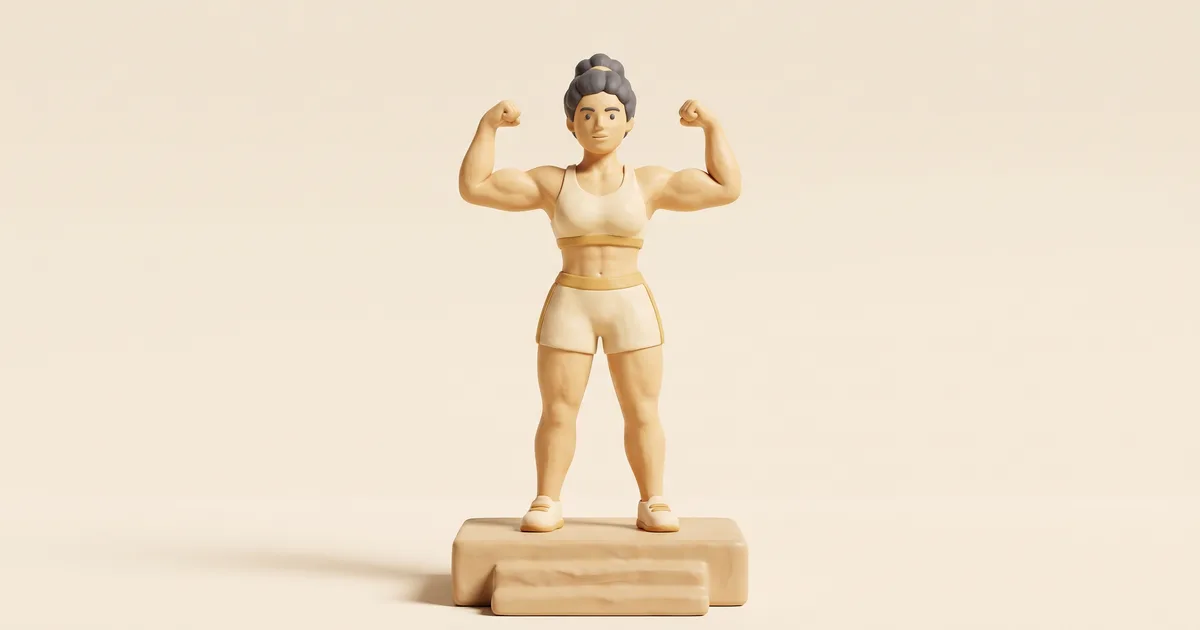
Interest in women's bodybuilding is surging. "Women's bodybuilding" searches rose 170% last year, and "bodybuilding women" and "women bodybuilding" each rose about 60%. Some of that is curiosity about the competitive sport. Much of it comes from women who simply want to build muscle and wonder whether they should train differently from men.
This guide covers both: how women can train and eat to build muscle, and how the competitive divisions work, from Bikini to Bodybuilding.
The short answer
- Women build muscle with the same principles as men: progressive overload, enough volume and enough protein.
- Women gain muscle at a similar relative rate to men early on, but from a lower starting point, so absolute gains are smaller.
- Women often recover faster between sets and sessions and may tolerate slightly more volume.
- Train each muscle 2× per week, 10–20 hard sets per muscle per week, 6–15 reps.
- Competitive divisions range from Bikini (least muscular) to Bodybuilding (most muscular).
Do women need to train differently?
Mostly, no. Research on sex differences in training shows:
| Factor | What research suggests | Practical takeaway |
|---|---|---|
| Relative muscle growth | Similar % gains to men in the short term | Same programs work |
| Absolute strength and size | Lower on average, especially upper body | Upper body may need extra focus |
| Fatigue resistance | Women often fatigue less at the same relative intensity | Rest periods can be a little shorter; volume may be slightly higher |
| Recovery between sessions | Often similar or faster | Training 2–3× per muscle per week works well |
| Menstrual cycle | Effects on performance are small and highly individual | Train by feel; no need to rigidly periodise around the cycle |
The biggest difference is often priorities. Many women focus on glutes, legs and shoulders. Bodybuilding lets you shape your program around that.
A 4-day women's bodybuilding plan
Mon: Lower A (glute focus) · Tue: Upper A · Thu: Lower B (quad focus) · Fri: Upper B
| Lower A (glutes) | Sets × reps |
|---|---|
| Hip thrust | 4 × 8–12 |
| Romanian deadlift | 3 × 8–10 |
| Bulgarian split squat | 3 × 10 per leg |
| Cable kickback or band abduction | 3 × 12–15 |
| Lying leg curl | 3 × 10–15 |
| Upper A | Sets × reps |
|---|---|
| Lat pulldown | 3 × 8–12 |
| Dumbbell bench or incline press | 3 × 8–12 |
| Seated cable row | 3 × 10–12 |
| Lateral raise | 4 × 12–20 |
| Triceps + biceps superset | 2 × 12–15 each |
| Lower B (quads) | Sets × reps |
|---|---|
| Squat or hack squat | 4 × 6–10 |
| Leg press | 3 × 10–15 |
| Walking lunges | 3 × 12 per leg |
| Leg extension | 3 × 12–15 |
| Calf raise | 3 × 12–20 |
| Upper B | Sets × reps |
|---|---|
| Overhead dumbbell press | 3 × 8–12 |
| Chest-supported row | 3 × 10–12 |
| Pull-ups (assisted if needed) | 3 × 6–10 |
| Rear-delt fly | 3 × 15–20 |
| Cable crunch / leg raise | 3 × 12–15 |
Progress with double progression: reach the top of the rep range on all sets, then add weight. Why it works: progressive overload.
Track this free in GymMonster — on iOS, Android, or right inside Telegram.


Nutrition for women who bodybuild
| Target | Guideline |
|---|---|
| Protein | 1.6–2.2 g per kg of bodyweight daily |
| Building phase | Small surplus, about +150–300 kcal/day; aim to gain about 0.25% of bodyweight per week |
| Fat-loss phase | Deficit of about 300–500 kcal/day; keep protein high and keep lifting heavy |
| Iron and calcium | Pay attention, especially with heavy training or a plant-based diet |
| Creatine | Effective and well researched for women too |
See our bodybuilding diet food list for meal ideas and supplements for bodybuilders for what's worth buying.
Competitive women's bodybuilding divisions
If you're thinking about competing, you'll need to choose a division. They differ mainly in how much muscle and conditioning the judges want to see:
| Division | Look judged | Posing |
|---|---|---|
| Bikini | Athletic, toned, balanced; less muscle, softer conditioning | Front and back poses, model walk |
| Wellness | More lower-body and glute development, fuller look | Similar to bikini, emphasising the lower body |
| Figure | Wider shoulders and back, small waist ("V-taper"), visible muscle separation | Quarter turns |
| Women's Physique | More muscular and conditioned, athletic | Mandatory poses plus a routine |
| Bodybuilding | Maximum muscle size with extreme conditioning | Full mandatory poses and routine |
Our full bodybuilding divisions guide compares the men's categories too. For a drug-free approach, look at natural bodybuilding federations, which test athletes.
Common mistakes women make
- Training too light for fear of "bulking." Challenging weights close to failure are what build shape.
- Only training glutes and legs. Shoulders and back create the proportions most divisions reward.
- Eating too little. Chronic under-eating stalls muscle growth and recovery.
- Doing endless cardio. Some is healthy; too much gets in the way of building muscle.
- Not tracking. Changes are slow and hard to see in the mirror. Numbers show you're progressing.
Track your progress
Building muscle is slow, and the mirror is a poor judge of progress. Your logbook isn't. When your hip thrust goes from 60 to 100 kg and your pull-ups go from band-assisted to bodyweight, you know it's working.
GymMonster logs every set, keeps your personal records and shows your training balance on a muscle heatmap, so you can see which body parts get enough work.
The bottom line
Women's bodybuilding uses the same principles that work for anyone: progressive overload, 10–20 hard sets per muscle per week, each muscle twice a week, and enough protein. Build your program around your goals, whether that's glutes, shoulders or the whole physique, and if you want to compete, pick the division that fits your build.
Frequently asked questions
Should women train differently from men to build muscle?
Mostly no. Women build muscle with the same principles: progressive overload, sufficient volume and adequate protein. Women may recover slightly faster between sets and can often handle a bit more volume.
How much protein do women need to build muscle?
About 1.6–2.2 grams per kilogram of bodyweight per day, spread across meals.
What are the women's bodybuilding divisions?
From least to most muscular: Bikini, Wellness, Figure, Women's Physique and Bodybuilding. Exact criteria vary by federation.
Can women get bulky from lifting weights?
Not accidentally. Building large amounts of muscle takes years of deliberate training and eating in a surplus. Most women who lift develop a toned, athletic shape.
Start tracking your workouts free
GymMonster is free on iOS and Android — or open it right inside Telegram, no download needed. Log your first set in under a minute.